

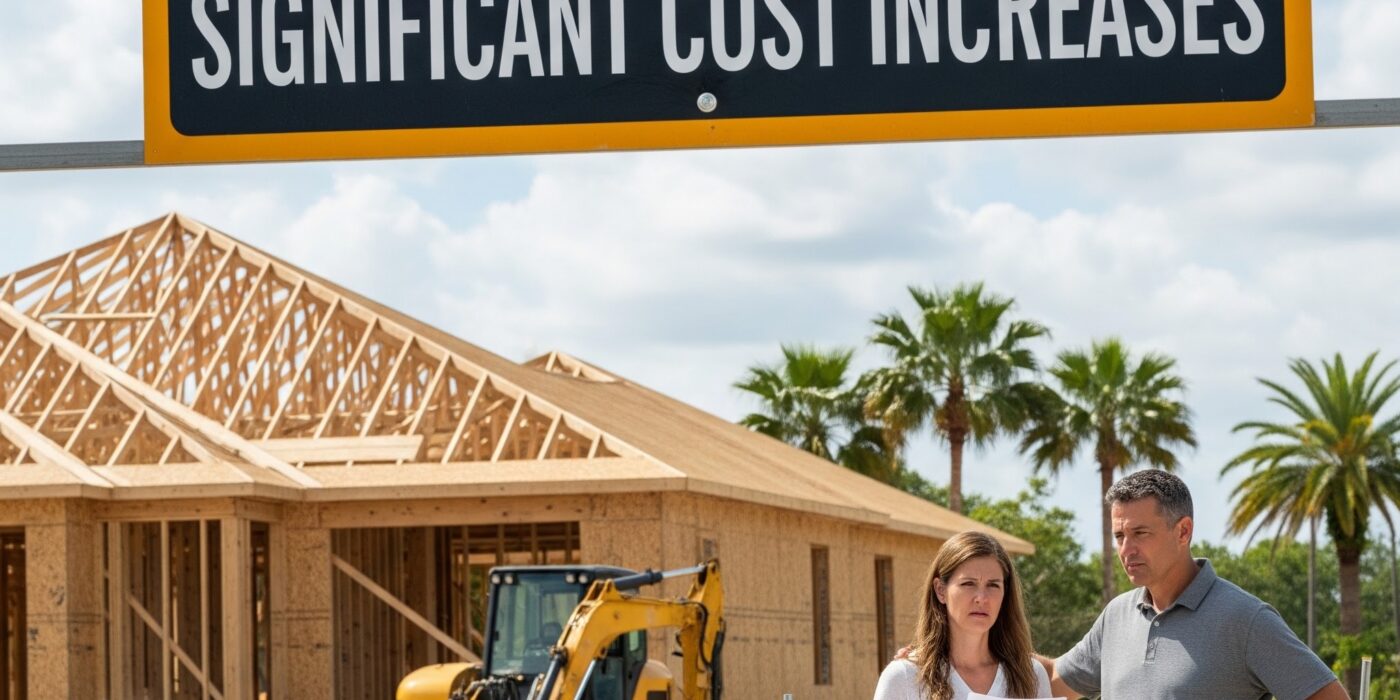
Why Construction Delays Are Costing Florida Buyers More Than Ever
Most people think the most expensive part of building a home in Florida is the price per square foot.
It isn’t.
It’s the time between breaking ground and moving in — and right now, that time is costing Florida buyers and developers more than most of them have calculated.
The Delay Problem Nobody Prices In
Here’s how the traditional Florida new construction conversation goes: a buyer signs a contract, a developer projects a 12 to 14-month build timeline, and everyone proceeds on the assumption that the schedule is roughly accurate.
It rarely is.
The national average for new residential construction delays has stretched significantly over the past three years. In Florida specifically — where weather windows are unpredictable, labor markets remain tight, and supply chain disruptions haven’t fully resolved — the gap between projected and actual completion dates has become one of the most significant financial risks in any new development transaction.
What makes this particularly damaging right now is the environment in which those delays are occurring.
This isn’t 2021, where rising prices meant that a delayed project was often worth more by the time it completed. In today’s Florida market, time is working against buyers and developers alike — and every month of delay compounds the damage.
What a Delay Actually Costs in 2026
When most buyers think about a construction delay, they think about inconvenience. Extended temporary housing. Disrupted plans. Frustration with a contractor who keeps moving the finish line.
The financial picture is considerably more serious than that.
Consider what a six-month delay actually triggers for a typical Florida buyer or developer:
Carrying costs on capital: Every month a project sits unfinished is a month of interest on construction financing, land holding costs, and any bridge financing in place. At current rates, six months of unnecessary carry on a $600,000 construction loan represents $18,000 to $24,000 in direct cost — before a single finishing decision has been made.
Extended temporary housing: A buyer displaced from their intended move-in date by six months in a Florida rental market that remains expensive is absorbing $2,500 to $5,000 per month in housing costs they hadn’t budgeted for. That’s $15,000 to $30,000 in unplanned expenditure.
Rate lock expiration: Buyers who secured mortgage rate locks at contract are watching them expire during construction delays. In a rate environment where even a 0.25% shift meaningfully alters monthly payments, re-locking at a higher rate after a six-month overrun is a direct, quantifiable financial loss on every payment for the life of the loan.
Market timing risk: In a declining or stabilizing market, a project that was priced correctly at the time of contract may face appraisal challenges by the time it completes. Delays don’t just cost money — they shift the buyer into a different market moment than the one they underwrote.
Add those figures together and a six-month delay on a mid-range Florida new construction project can represent $40,000 to $70,000 in total financial impact. For a luxury or investment-grade project, that number climbs considerably higher.
Why Traditional Construction Keeps Missing the Schedule
Understanding the cost of delays is only useful if you understand why they happen — because the causes aren’t random. They’re structural features of the conventional build model.
Weather dependency: Site-built construction in Florida is fundamentally exposed to weather. A wet season that runs long, a named storm that shuts down a job site for two weeks, or a series of afternoon thunderstorms that consistently interrupt pour schedules — these aren’t exceptions. They’re the calendar. Yet traditional build timelines are routinely projected as though Florida’s weather will cooperate.
Trade sequencing fragility: Conventional construction depends on a choreography of independent subcontractors — framing crews, MEP trades, drywall, finish work — each of whom operates on their own schedule and their own capacity constraints. When one trade runs late, every subsequent trade is delayed. There is no buffer built into the model because the model wasn’t designed with buffers in mind.
Labor market reality: Florida’s construction labor market has not recovered to pre-pandemic depth. Skilled trade availability — particularly framing, electrical, and plumbing — remains constrained in the high-growth corridors where most new development is concentrated. Developers competing for the same subcontractor pools in Sarasota, Manatee, and Charlotte counties are discovering that scheduling promises made at contract signing don’t survive contact with actual availability.
Material procurement fragility: Supply chain disruptions have moderated but not resolved. Long-lead items — windows, HVAC systems, engineered components — continue to carry extended lead times. A single late delivery can idle an entire job site for weeks.
The traditional build model wasn’t designed to be resilient against these pressures. It was designed for a more stable, more predictable operating environment that no longer exists in Florida.
The Market Doesn’t Wait for Delayed Projects
There’s a dimension to construction delays that rarely appears in project pro formas but materially affects outcomes: the market doesn’t pause while a delayed project catches up.
Florida’s top-growth corridors — the Southwest Florida growth corridor, inland Central Florida, Northeast Florida’s master-planned communities — are attracting significant developer competition. Lakewood Ranch, Babcock Ranch, and Wellen Park collectively sold thousands of homes last year, outperforming the broader market not just on volume but on velocity.
What gives integrated, systems-driven communities that velocity advantage? Among other factors: predictable delivery timelines that allow buyers to plan, commit, and close with confidence. When a development can reliably say “your home will be complete in this window,” it commands buyer confidence that a conventional builder running six months late simply cannot.
For investors and developers, the calculus is direct. A build-to-rent project that delivers on schedule generates rental income on schedule. A project that runs six months late delivers six months of vacancy instead. On a 20-unit development, that vacancy cost isn’t theoretical — it’s the difference between a deal that performs and one that doesn’t.
What Construction Certainty Actually Looks Like
The antidote to delay isn’t optimism. It’s system design.
The most significant advances in Florida construction delivery aren’t happening on individual job sites. They’re happening in the methodology — specifically in the shift toward integrated, systems-built approaches that remove the primary variables responsible for delay.
Factory-built components eliminate weather dependency from the most critical build phases. When structural panels are manufactured in a controlled environment and delivered to site ready for assembly, the Florida afternoon thunderstorm becomes irrelevant to the schedule.
Integrated delivery models — where engineering, structural systems, MEP coordination, and finishing operate under a single aligned execution framework rather than a fragmented subcontractor chain — eliminate the trade sequencing fragility that turns one delay into five.
Precision-engineered build systems compress the on-site construction window itself. Projects that traditionally required 12 to 18 months of site activity can be delivered in dramatically shorter timeframes when the structural system is designed for speed without compromising integrity.
Upfront cost certainty removes the financial uncertainty that forces scope and schedule changes mid-project — one of the most common but least discussed causes of delay in conventional builds.
This isn’t theoretical. Modular and systems-built construction is already demonstrating two-week on-site assembly timelines for certain residential typologies in Florida. The technology exists. The methodology is proven. The question is which developers choose to deploy it.
The Risk Is Already on the Clock
Florida buyers and developers who are underwriting new construction projects right now need to be asking a harder question than “what’s the cost per square foot?”
The right question is: what does this project cost if it delivers six months late?
In most cases, the answer to that question should be changing the construction conversation entirely — from which contractor offers the lowest bid to which delivery system offers the highest certainty.
Because in Florida’s current market, the cheapest build isn’t the one with the lowest contract price.
It’s the one that delivers on time.
Are construction timelines factoring into how you’re evaluating new development opportunities in Florida right now? What’s the most significant delay-related cost you’ve encountered on a recent project? Drop a comment or send a message — the shift toward construction certainty is one of the most important conversations happening in Florida development right now.
#FloridaRealEstate #ConstructionDelay #Constructonik #FloridaDevelopment #NewConstruction #HousingInnovation #RealEstateInvesting #ModernConstruction